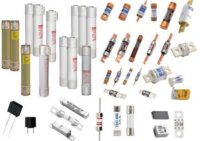
 Fuses are one of the two most commonly used devices for electrical equipment, personnel protection, and overall circuit safety. They are widely applied to control and power transformer primary and secondary circuits, as well as similar control circuits. Their popularity is due to their compact size, broad range of voltage, current, and time-delay options, predictable operating characteristics, tolerance to ambient heat, fast-acting interruption to protect sensitive control circuits, and the ability to precisely select a fuse type and rating for a specific application.
Code Requirements
The NEC® and CEC require motor branch circuits to be protected against both overloads and short circuits.
-
Overload protection may be provided by fuses, overload relays, or motor thermal protectors.
-
Short-circuit protection may be provided by fuses or circuit breakers.
Motor Protection Fuse Characteristics
Motor protection fuses are designed to provide high reliability under cyclic and peak current conditions. They incorporate age-resistant technology to withstand high inrush currents associated with motor starting while maintaining dependable long-term performance.
When an overload relay or motor thermal protector is included in the branch circuit, motor branch-circuit fuses may be sized larger. If the fuse ratings listed in Table 2 do not allow the motor to start:
-
Time-delay fuses may be increased up to 225% of motor full-load current.
-
Non–time-delay fuses may be increased up to 400% (or 300% for motors over 600 A).
Some motor starters may not be adequately protected at the maximum fuse sizes shown in Table 2. In such cases, UL 508 requires the starter manufacturer to mark the maximum permissible fuse size on the starter. When this marking is present, the indicated maximum rating must not be exceeded.
Protecting IEC-Style Motor Starters
IEC (European-style) motor starters and contactors are increasingly popular due to their reduced size and lower cost. However, they generally have a lower short-circuit withstand capability than NEMA-rated starters, which requires careful selection of protective fuses to ensure adequate protection.
Calculating Fuse Ratings for AC Motor Protection
Fuse ratings for AC motor protection are determined based on the motor’s full-load current.
-
Using Motor Protection Tables:
Fuse ratings selected according to standard AC motor protection tables comply with NEC® requirements for motor branch-circuit and short-circuit protection. -
Based on Actual Motor Full-Load Amps:
The most effective protection is achieved by selecting fuse ratings based on the motor’s actual full-load amperes (FLA) as listed on the motor nameplate. Identify the motor’s nameplate FLA in the column corresponding to the motor type and required protection, then read across to determine the recommended fuse ampere rating.