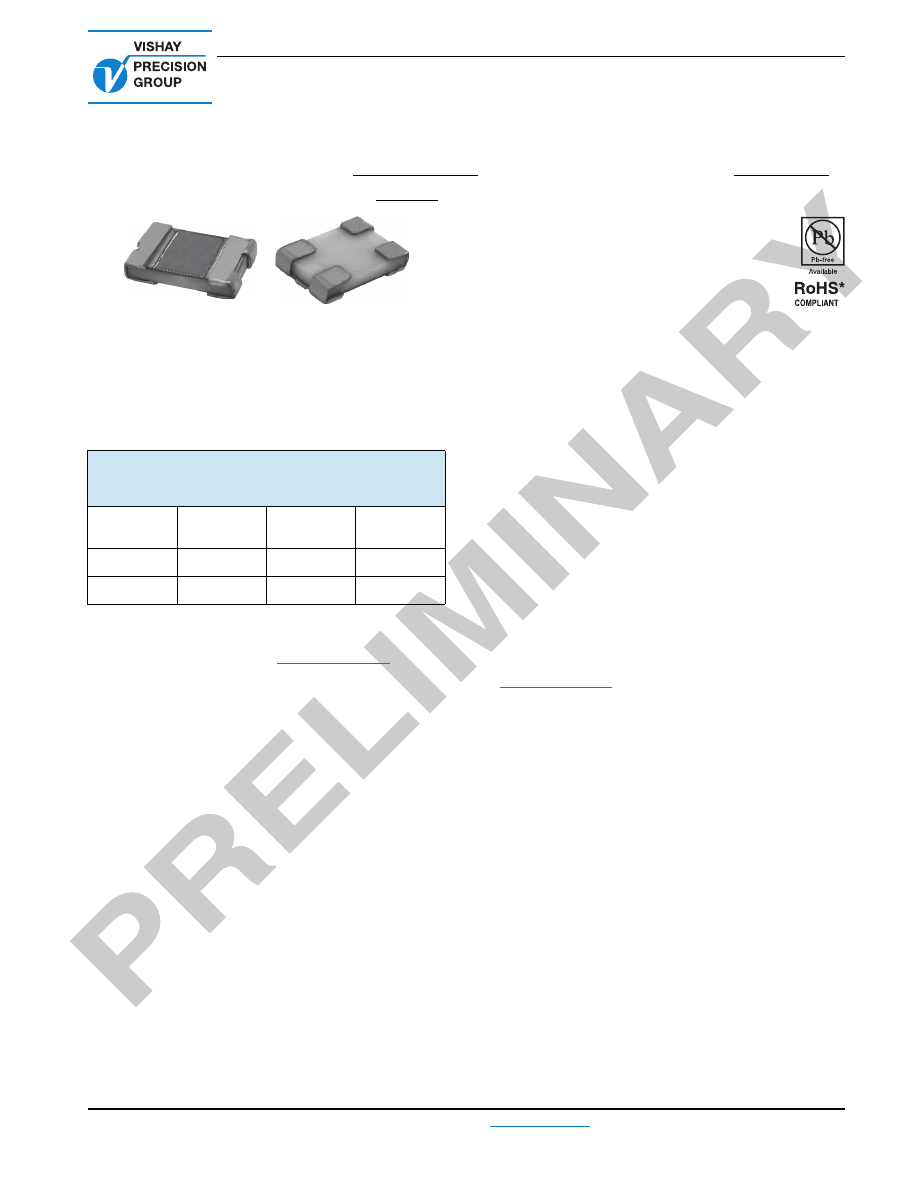
High Precision Foil Surface Mount Current Sensing Chip
Resistors with TCR of ± 2 ppm/°C, Load Life Stability of ± 0.02 %,
ESD Immunity up to 25 kV and Fast Thermal Stabilization
VCS1610 (Kelvin Connection)
Vishay Foil Resistors
Document Number: 63137
For any questions, contact:
foil@vishaypg.com
www.foilresistors.com
Revision: 25-Mar-10
1
TERMINATIONS
Two lead (Pb)-free options are available:
Gold plated or tin plated
Tin/lead plated
Note
• Tighter tolerances and higher values are available. Please
contact application engineering
foil@vishaypg.com
FEATURES
Temperature coefficient of resistance (TCR):
± 2.0 ppm/°C typical (- 55 °C to + 125 °C,
+ 25 °C ref.) (see table 1)
Tolerance: to ± 0.5 %
Load life stability:
± 0.02 % at 70 °C, 2000 h at rated power
Power rating: 0.25 W at + 70 °C
Resistance range: 0.1
to 1
(for higher or lower
values please contact Vishay application engineering
department)
Vishay Foil resistors are not restricted to standard values;
specific “as required” values can be supplied at no extra
cost or delivery (e.g. 0.2345
vs. 0.2
)
Electrostatic discharge (ESD) up to 25 000 V
Thermal stabilization time < 1 s
Short time overload
0.005 %
Non-inductive, non-capacitive design
Thermal EMF: 0.05 µV/°C typical
Current noise: < - 42 dB
Rise time: 1 ns effectively no ringing
Voltage coefficient: < 0.1 ppm/V
Non inductive: < 0.08 µH
Weight: 0.027 mg
Compliant to RoHS directive 2002/95/EC
Prototype quantities available in just 5 working days
or sooner. For more information, please contact
foil@vishaypg.com
For improved performances, please see VCS1610Z
INTRODUCTION
Why should I use the VCS1610?
The VCS1610 is a current sensing solution that was
developed with a low TCR to meet demands for new and
stable resistive product solutions in the industry today. This
resistor is most-often used to monitor a current that is directly
proportional to some physical characteristic (such as
pressure, weight, etc) being measured by an analog sensor.
The resistor converts the current to a voltage that is
representative of the physical characteristic and feeds that
voltage into control circuits, instrumentation, or other
indicators.
Variations induced in the resistor, not representative of the
monitored characteristic, can be caused by high TCR
response to both ambient temperature and self-heating and
can feed erroneous signals into the system. Resistance is
usually kept low to reduce the I²R self-heating (Joule effect)
portion of the error while minimizing the stresses that cause
long-term resistance changes. It is critical for this resistor to
reach thermal equilibrium quickly in circuits that require fast
response or where the current changes quickly.
The VCS1610 is used where the emphasis is on accuracy
and repeatability under stress conditions in applications
requiring precision resistor performance up to 0.25 W and up
to 70 °C. Applications as EB systems, switching power
supplies, force-balanced scales all rely on current sense
resistors to develop a precise voltage proportional to the
current. The VCS1610 is a four terminal resistor which is
essential to achieve high accuracy and stability.
Why use Kelvin connections?
Four-terminal connections or Kelvin connections are
required in these low ohmic value resistors to measure a
precise voltage drop across the resistive element. The
4-terminal configuration eliminates the IR-drop error voltage
that would be present in the voltage sense leads if a standard
two-terminal resistor were used.
In current sense resistors the contact resistance and the
terminations resistance may be greater than that of the
resistive element itself so lead connection errors can be
significant if only two terminal connections are used.
* Pb containing terminations are not RoHS compliant, exemptions may apply
TABLE 1 - TOLERANCE AND TCR VS.
RESISTANCE VALUE
(- 55 °C to + 125 °C, + 25° Ref.)
VALUE
(
)
TOLERANCE
TYPICAL
TCR
MAXIMUM
TCR
0R5 to 1R
0.5 %, 1 %
± 2 ppm/°C
± 10 ppm/°C
0R1 to 0R5
0.5 %, 1 %
± 2 ppm/°C
± 15 ppm/°C