Thermistors
Thermistors are among the most accurate temperature-sensing components available. They are resistive devices whose resistance changes significantly with temperature, making them suitable for applications such as temperature sensing, inrush current limiting, self-resetting overcurrent protection, and self-regulating heating elements.
Thermistors are classified based on the sign of k, the first-order temperature coefficient of resistance. When k is positive, resistance increases as temperature rises; these devices are known as Positive Temperature Coefficient (PTC) thermistors, or posistors. When k is negative, resistance decreases with increasing temperature, and the device is called a Negative Temperature Coefficient (NTC) thermistor. Both PTC and NTC thermistors are widely used in applications including digital thermostats, battery packs, televisions, and automotive systems. In particular, NTC thermistors are commonly used to measure coolant and oil temperatures in vehicles.
NTC thermistors are defined by parameters such as their nominal resistance at a reference temperature—typically 25 °C—and their B value, which describes the temperature-to-resistance relationship over a specified range. These characteristics make NTC thermistors especially well suited for precise temperature measurement and control applications.
Showing 1–9 of 18 results
-
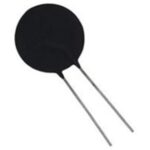
1DA101K-EC RTI NTC THERMISTOR 100OHM 10% 2Pin DISC
Read more -
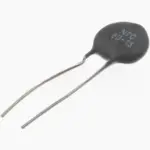
B57364S0259M000 TDK Epcos Thermistor 2.5 Ohms 11A 2Pins
Read more -
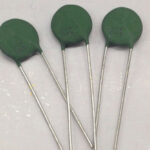
CWF2-502H3470 NANJING NTC THERMISTOR 5KOHM 3% 3470K
Read more -
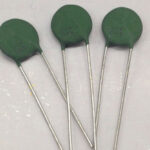
DHT0A103J39H2SY THINKING Thermistor NTC 10Kohm Radial
Read more -
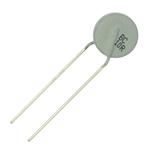
EPCOS B57237S509M Inrush Current Limiters 5 Ohms 5amps 2900k
Read more -

EPCOS B59603A0085A062 PTC THERMISTORS 470 OHM 15% 85C SMD 0603
Read more -
MS22 20005-A Ametherm Thermistor 20Ohm 5A Radial
Read more -
MS22 20005-B Ametherm Thermistor 20 OHM 5A Disc
Read more -
MS22-10008-A Ametherm Thermistor 10Ohm 8A Radial
Read more