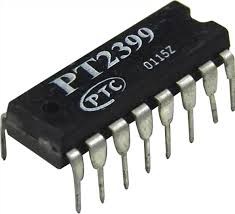
Description
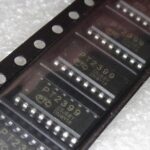
The PT2399 is a CMOS echo/delay processor developed by Princeton Technology Corp. This digital chip includes an ADC (Analog to Digital converter), 44Kb of RAM to store the samples and a DAC (Digital to Analog converter). Although this chip was created as a simple solution to add delay/reverb/echo to karaokes and set-up entertainment systems, it became very popular in the guitar pedal community due to its ability to emulate BBD-based delay circuits, good price, through-hole package, 5V power supply and tolerance to modifications.
This integrated circuit has also demonstrated that with a careful design and good tuning, could be a fantastic sounding solution. Many well-known effects like Belton/Accu-Tronics reverb module, Danelectro FAB-Echo, and the Rebote Delay use this chip as the core of the circuit.
With a minimum delay of 30ms and a maximum of 340ms (that could be extended up to 1 second at the expense of sound quality) makes it perfect for delay, echo and reverb effects.
The official Princeton Technology PT2399 datasheet is vague and many of the internal functions of the IC are not explained either, giving the foundations for mods and think-out-of-the-box solutions. In this article, we are trying to give more insights and information about how this chip works.
The PT2399 is powered using 5V. In order to preserve the signal quality and reduce noise, it is convenient to use a dedicated supply or regulator. The part consumes a maximum current of 30mA (it decreases when the delay time is increased).
The Princetown PT239X series includes several ICs with similar capabilities, these are the most popular and available:
PT2395: 40pins, requires an external DRAM memory (IC 41256 or 4164). It supports short/long mode (64Kb or 256Kb RAM) giving 800ms delay max (extended to 1.5 with noise). Voltage controlled delay time. The shortest delay possible around 10ms (not good for chorus/flanger). Good for long delay/echo.
PT2396: 24 pins, internal 48Kb memory. It requires an external 2MHz clock and the delay time is set using a serial data communication (a microcontroller is needed). The minimum delay time is 12ms and the maximum 192ms. Its availability is limited.
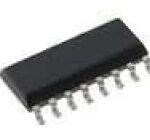
PT2399: 16 pins, the most popular due to its ease of use and availability. With 44Kb internal RAM, the time is set using an external resistor which makes it perfect to simplify the circuit. It has a minimum delay of 30ms and a maximum of 340ms.